
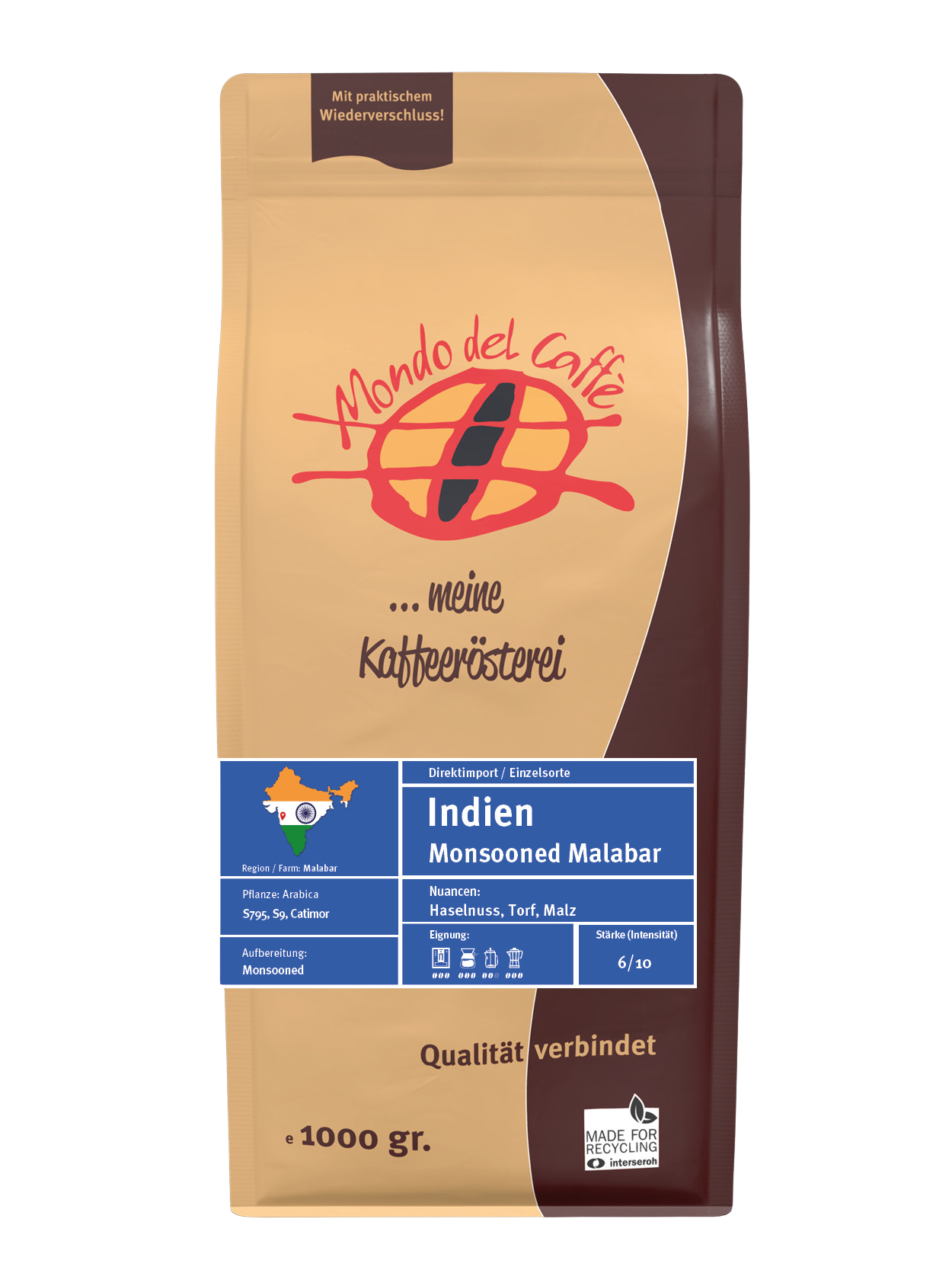
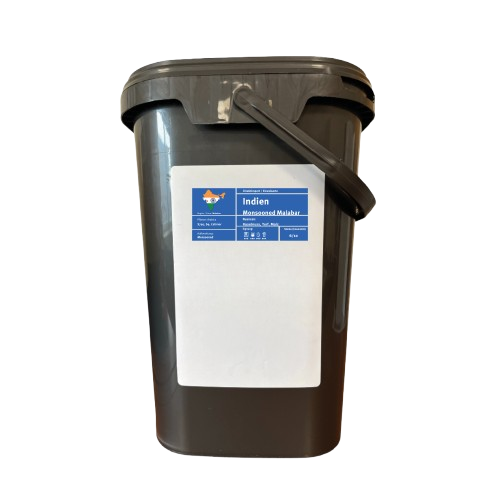
Experience the unique India Monsooned Malabar coffee, 100% Arabica, directly from the Malabar coastal region. Through the traditional monsooning process, in which the beans are exposed to the humid monsoon climate, this roasted coffee acquires its distinctive aroma profile: earthy, nutty, and malty, with subtle notes of peat.
Thanks to its low acidity, this coffee is particularly gentle on the stomach and ideal for daily enjoyment. Its full-bodied, velvety texture delights lovers of strong coffees who appreciate mild digestibility.
Ideal for portafilter machines, filter coffee or French press – this Monsooned Arabica coffee from India impresses with its quality, tradition and character.
The monsooning processing method for coffee from the Malabar region
The Malabar region in southwestern India is renowned for its unique coffee processing method: monsooning. This technique, closely linked to the region's climate, imparts a distinctive flavor and character to the coffee. In this article, we explore the background, process, and specific characteristics of monsooning Malabar coffee.
History and origin of monsooning
The monsooning method originated in the 18th century during the era of maritime trade between India and Europe. Coffee was transported on sailing ships, a journey that took several months. During this long voyage, the coffee was exposed to monsoon winds and humid sea air, which significantly altered its flavor. Europeans developed a preference for this distinctive taste, and as transport times shortened with the advent of steamships, producers sought ways to reproduce this unique flavor. This led to the development of the controlled monsooning process.
The monsooning process
The monsooning process begins after the coffee beans are harvested. First, the beans are sun-dried and then packed into jute sacks. These sacks are then stacked in well-ventilated warehouses along the coastline of the Malabar region. During the monsoon season, which lasts from June to September, producers regularly open the sacks to expose the beans to the humid, salty air.
This process is repeated over a period of 12 to 16 weeks. During this time, the beans absorb moisture, swell, and change color from green to pale gold. The moisture content of the beans rises to as much as 16%, which drastically alters the taste and aroma of the coffee. After the monsooning process, the beans are dried again to bring the moisture content to a stable level and then carefully sorted and packaged.
Taste and special characteristics of Monsooned Malabar coffee
Monsooned Malabar coffee is characterized by its smooth, mild flavor, low acidity, and thick, syrupy consistency. Aromas of chocolate, spices, peat, and nuts are frequently described, making it particularly popular with espresso lovers. These flavor profiles make Monsooned Malabar an excellent choice for blends that require a deep and rich taste.
Advantages and challenges of monsooning
A major advantage of the monsooning process is the ability to refine the coffee naturally without the use of chemical additives. This makes monsooned Malabar coffee an ecologically sustainable product. However, the process is also labor-intensive and weather-dependent, which can lead to fluctuations in quality and availability.
Conclusion
The monsooning processing method is a fascinating example of how regional climate conditions and historical trade routes can influence coffee production. Monsooned Malabar coffee remains a specialty, prized by coffee connoisseurs worldwide, thanks to its unique taste and aroma. We invite you to try our India Monsooned – as a classic roast for your fully automatic coffee machine or as an espresso.
| Taste | nutty, spicy |
|---|---|
| Processing | monsooned |
| Roast | medium roast |
| Properties | Direct import, Single Origin / Single Variety |
| Nuances | Hazelnut, peat, malt |
| Intensity |
Strong
|
| Suitability | Fully automatic, portafilter, Espresso maker, filter, French Press |
We recommend using approximately 8-9g of our India Monsooned per cup. This allows it to develop its full, nutty, and spicy character. You'll be impressed by the rich crema. If your machine allows for pre-infusion, we recommend about 3-5 seconds. The brewing temperature should not exceed 96°C. When brewing our India Monsooned in a French press or Chemex, simply boil your water and then let it cool for 1.5-2 minutes with the lid open. Please do not brew with boiling water, as this can make the India Monsooned bitter.
| Brewing temperature | 91-96°C |
|---|---|
| Dosage recommendation | 8-9 g / 140 ml |
| Farmer | Aspinwall |
|---|---|
| Origin country | India |
| Region | Malabar |
| Plant | S795, S9, Catimor |
| Processing method | monsooned |
| Harvest season | Mai - Juni |
| Microbial properties | nicht vorhanden |
|---|---|
| Storage information | Kühl (nicht im Kühlschrank lagern, so lang nicht in Vakuum o.ä. verpackt), Trocken, vor Luft und vor Licht geschützt |
| Durability | ca. 12 Monate |
| Nutritional values | Röstkaffee ist nicht kennzeichnungspflichtig (EU-VO 1169/2011 Anhang V) |
| Allergens | Keine Allergene vorhanden (EU-VO 1169/2011 Anhang II) |
| GMO | nicht vorhanden |
| Ochratoxin A | < 5 μg/kg (EG-VO 1881/2006 - Anhang - Abschnitt 2.2.4. |
| Nitrogen content | nicht vorhanden |
| Sensitive consumers | Kinder und schwangere Frauen |
| Physical properties | Ganze, geröstete Kaffeebohnen; trocken; rieselfähig; sortentypische braune Färbung. |
| Organoleptic properties | Typischer Geruch und Geschmack nach geröstetem Kaffee; sortentypisches Aroma; frei von Fremdgeruch und Fremdgeschmack. |
| Biological properties | Mikrobiologisch stabiles Trockenprodukt. Für Röstkaffee bestehen keine spezifischen mikrobiologischen Kriterien gemäß VO (EG) Nr. 2073/2005. Die mikrobiologische Sicherheit wird im Rahmen der HACCP-Gefahrenanalyse sowie durch Gute Hygiene- und Herstellungspraxis sichergestellt. |
Gallery


