
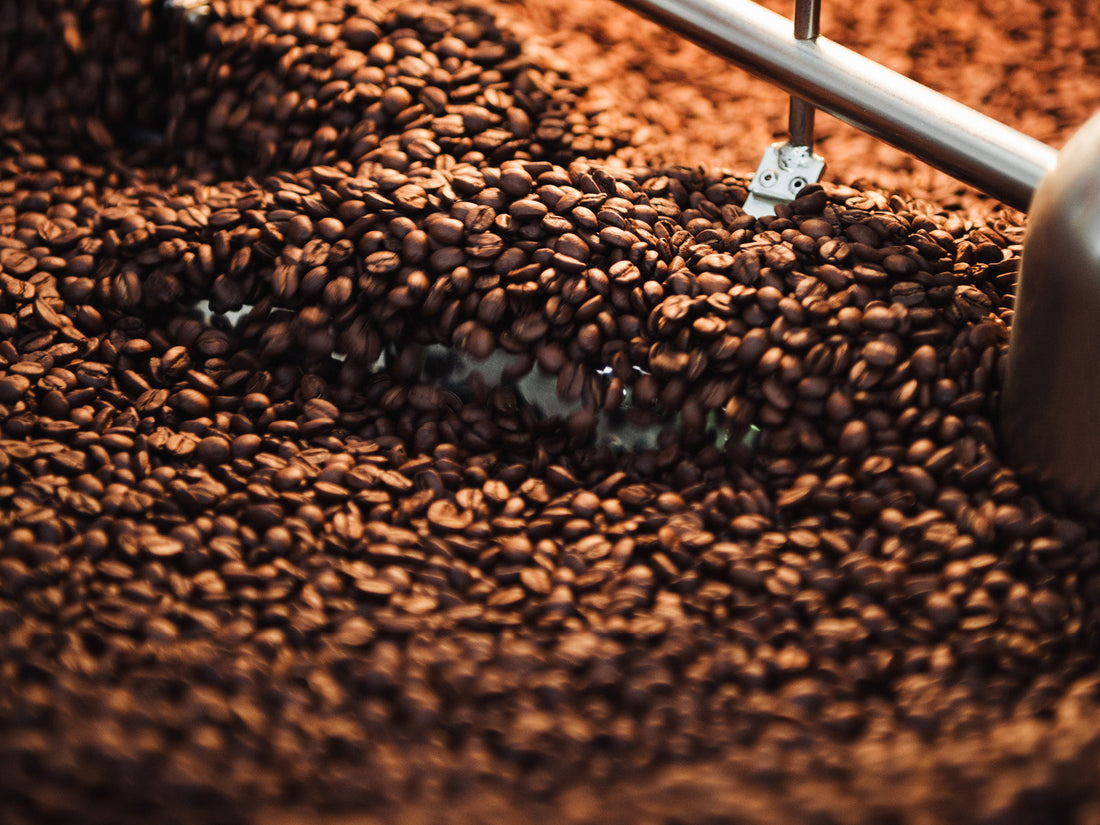
Basically, the roasting process can be divided into 3 phases:
Drying (or homogenization)
During the coffee drying phase, the heat application causes the beans to warm up and release moisture. This phase can take between 4 and 8 minutes. Typically, the beans lose 8 to 10% of their moisture and absorb energy in the form of heat. It is crucial that the moisture content is consistent across all raw beans after homogenization (drying). This consistency allows the process to move on to the next phase.
Tanning / The Maillard reaction
In the next phase, the beans absorb energy and the Maillard reaction begins. During this process, the sugars in the beans are broken down and reduced, and the amino acids are also broken down and rearranged. This is also known as pyrolysis. This reaction is responsible for the development of the different aromas and the characteristic color of coffee. During this process, the typical aroma of toast or freshly baked bread develops. We are approaching the transition to the next phase – the famous first crack.
Due to the previous phases, the beans are energized and greatly expanded. Here, the reaction, which has been endothermic (energy-absorbing), switches to an exothermic (energy-releasing) reaction, and the beans literally burst, which can be heard as a cracking sound in the roaster. Hence the name "First Crack."
Development
From this point on, the development or roasting phase begins. During this phase, the individual aromas of the coffee develop according to the desired profile. If the roasting process isn't stopped (by reducing the temperature, emptying the roaster, and cooling), the coffee can quickly taste burnt. However, stopping the process too quickly or without ensuring the coffee is properly roasted can result in a lack of energy and the full complexity of flavor. The typical length of the development time is roast-specific and depends on the desired aromas and subsequent brewing methods.
Generally
Furthermore, one needs to understand how the fan speed, i.e., the air circulation, and the regulation of the heating output affect the individual temperature curves and the duration of the phases. Over time, one has to develop a feel for which patterns and time periods are completely normal and when and how intervention is truly necessary.
Creating the perfect roasting profile always requires adjustments to the specific coffee, the amount of coffee grounds, and the roaster, and can be very time-consuming and involve numerous trials. Once you've taken the time to do this, you have a great template for future roasts of that coffee. A suitable roasting profile is the foundation for reproducible results and is essentially essential. After all, even 30 seconds more or less in the entire roasting process, under otherwise identical conditions and with the same procedure, can significantly affect the flavor.

And what does that look like at the Mondo del Caffè roastery?
You're welcome to see this for yourself at our location in Echternach – visit us at the coffee roastery and take a look behind the scenes. To give you a little taste, we've made a video for you.


