We knew, however, that we needed a different solution in the long term (ideally, 100% recyclable coffee packaging). But without compromising the quality of our coffee. Through our colleagues at Plastic2Beans in Cologne, we then connected with the packaging specialist Packiro (also from Cologne). Right from our first meeting in Echternach, we realized we were on the same wavelength and that Packiro shared the exact same requirements for their packaging. This also presents an opportunity to develop something together. The relative proximity (Echternach – Cologne) is also a great advantage.
We've now implemented our first mono-material packaging – and we're very proud of it. Starting in May, you'll find the first new packages in our stores, at specialty retailers, and at partner stores. They follow the Cradle to Cradle principle (you can find more information here). In the future, you'll be able to return the empty packages to our stores and participating businesses. From there, the packages will be sent to us before being delivered to the recycling center. There, they will be processed into granules and – you guessed it – then used to manufacture new coffee packaging for us.

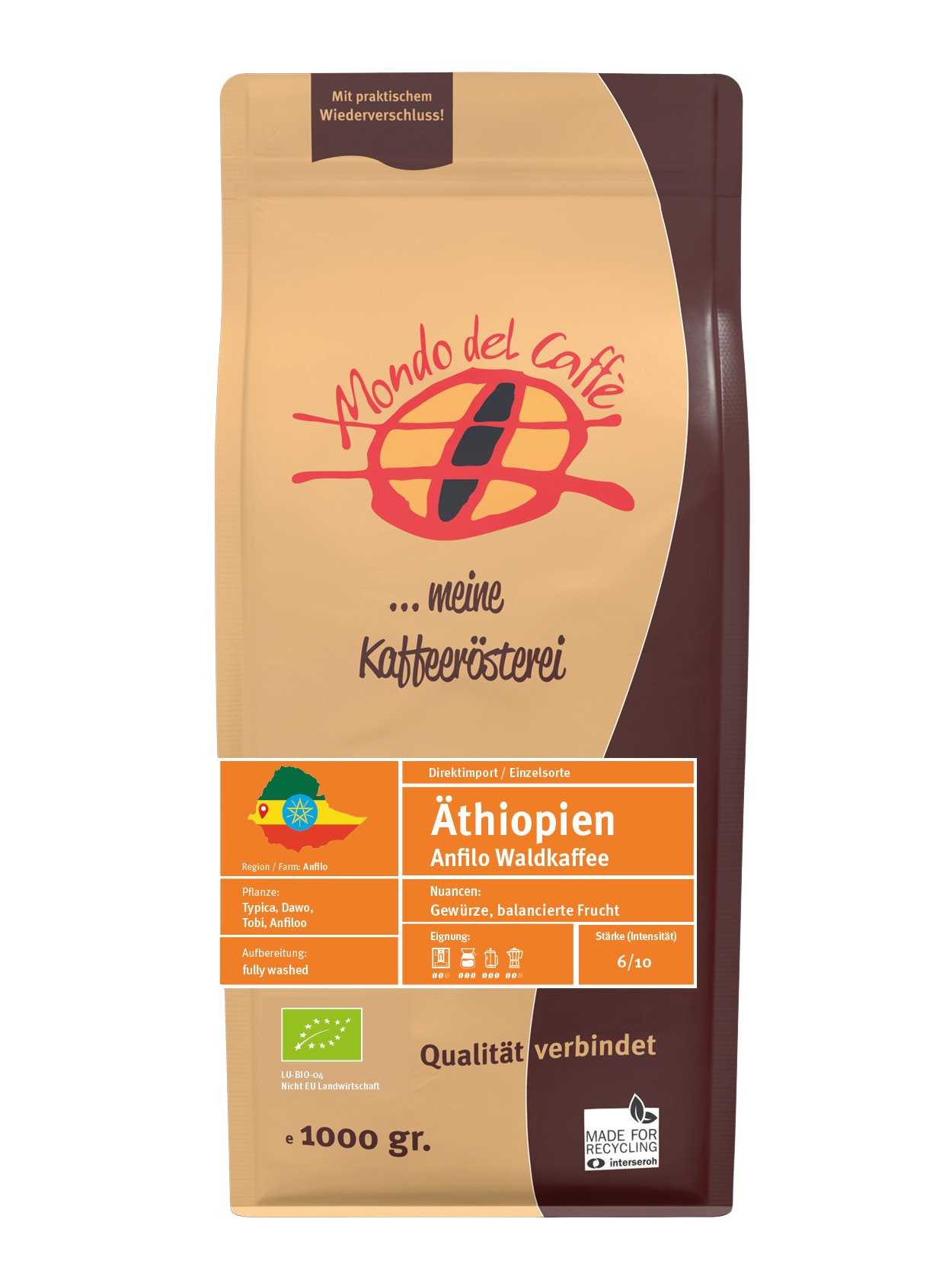
- With practical re-closure
- All information at a glance (On the new labels you will find all the information about your favorite coffee at a glance.)
- 100% recyclable (100% recyclable & sustainable coffee packaging based on the cradle-to-cradle principle.)
- Strong barrier properties (air and light) (Packaging made entirely from a single material! – 100% recyclable – strong barrier properties (air and light) – thus optimizing aroma protection)
- Optimized aroma protection
Circular economy
As part of our contribution to a functioning circular economy, we have collaborated with Packiro from Cologne to create a bag that is fully recyclable.
In practice, this means that waste is reduced to a minimum. Once a product has reached the end of its life cycle, the resources and materials remain in the economy as much as possible. They are thus reused productively to continue generating added value.
The circular economy stands in contrast to the traditional, linear economic model (“throwaway economy”).

The structure in detail
Our new packaging is impervious to moisture, oxygen, and UV rays. The thin, metallized inner coating blocks UV light completely, providing excellent UV protection for particularly light-sensitive products like coffee. The airtight seal achieved through thermal lamination eliminates the need for environmentally harmful, solvent-based adhesives.
To optimally protect the coffee, our plastic packaging also consists of several layers. The difference: These layers are all made of the same material (PP/PP/PP) and therefore do not need to be separated in the sorting facility. Afterwards, they can be recycled by type. The material recovered from the recycling process can be reused for new products.

The service provider assesses the recyclability of packaging using an independent, scientific evaluation method: developed and validated by the bifa Environmental Institute and the Fraunhofer Institute. If packaging achieves more than 18 out of a possible 20 points according to this method, it is allowed to bear the "Made for Recycling" seal. Just like our new packaging.

The circular economy is a model of production and consumption in which existing materials and products are shared, leased, reused, repaired, refurbished and recycled for as long as possible.
In practice, this means that waste is reduced to a minimum. Once a product has reached the end of its life cycle, the resources and materials remain in the economy as much as possible. They are thus reused productively to continue generating added value.
The circular economy stands in contrast to the traditional, linear economic model ("throwaway economy"). We as a coffee roastery and our customers have the opportunity to make a real impact through our choice of products and packaging.
Click here to visit our partner Packiro:


