
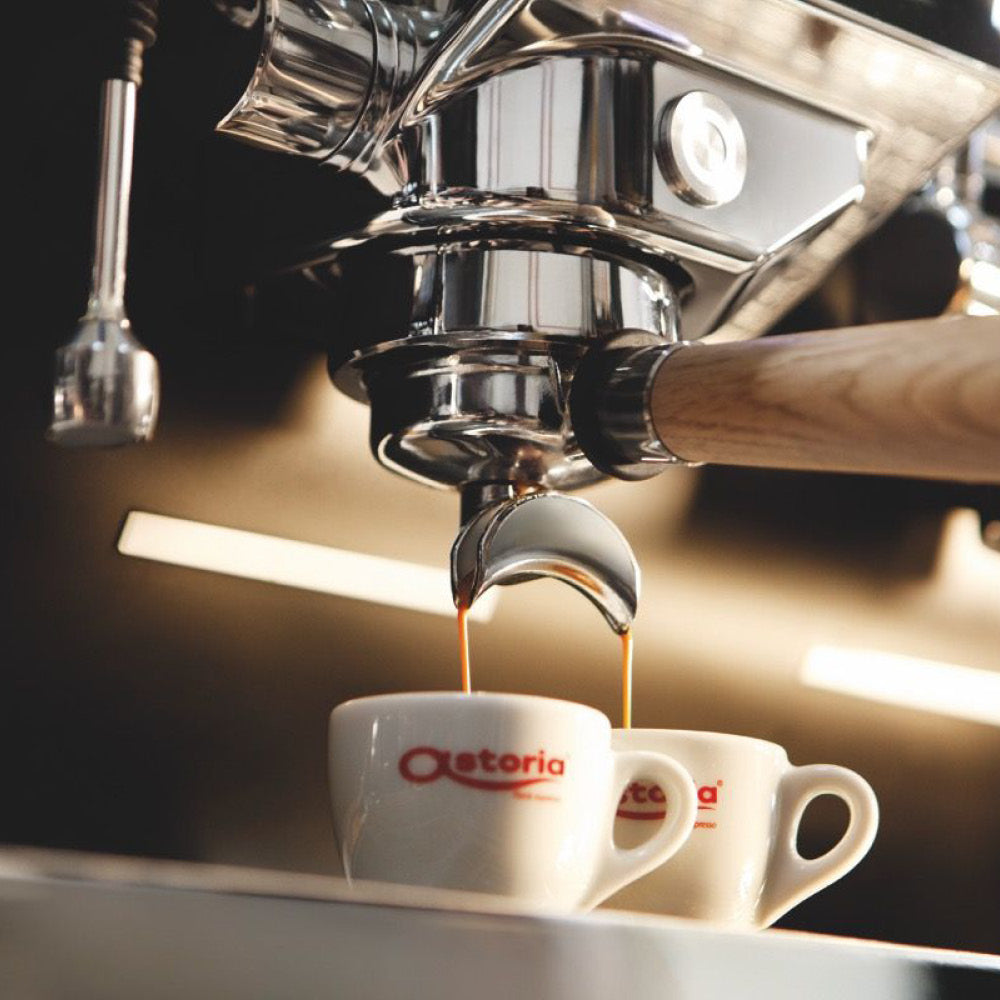
At Mondo del Caffè's roastery shop, you will find a selection of portafilter machines for all requirements in the exhibition.
How it works:
To summarize the basic function of an espresso machine, one could say the following: A portafilter machine is a semi-automatic coffee machine used to prepare coffee, espresso, and milk-based drinks. Inside the machine, water is heated to approximately 90°C–94°C in an electrically heated boiler or heat exchanger and forced through finely ground coffee/espresso powder at a pressure of about 9–10 bar. This pressure is generated by a built-in electric pump. To prevent the coffee/espresso powder from being stirred up in the portafilter and to ensure ideal extraction, the coffee or espresso powder must first be tamped (pressed down). This compacts the coffee/espresso powder, increasing the resistance of the flowing water and extracting more aroma into the cup.


Portafilter types:
There are three types of espresso machines: single-boiler, dual-boiler, and multi-boiler. You can find the differences between them here:
Single-circuit system (1 water circuit):
In a single-boiler system, the machine has one boiler that contains both the water for brewing coffee and the water for steaming. Therefore, if you have made an espresso and then want to froth milk, you would have to wait 2-3 minutes for the boiler to reheat.
- The most affordable espresso machines
- 1 boiler, 1 water circuit
- Water for coffee brewing and for hot steam is stored together in the boiler.
- Depending on the product, the machine then needs to heat up or cool down for a few minutes to reach the desired temperature.
- With vibration pump
- Perfect if you only want to make espresso, but rather unsuitable for many milk drinks due to the longer waiting time.

Dual-circuit system (2 water circuits):
In a dual-boiler system, the machine also has only one boiler, but it incorporates a heat exchanger within the boiler. The boiler itself primarily contains hot water vapor. As soon as brewing begins, the machine draws fresh water from the water tank into the heat exchanger cartridge. There, the water is heated as it passes through the heat exchanger and arrives at the brew head at the correct temperature.
- Prices in the mid-range
- 1 boiler, 2 water circuits
- If the machine is left standing for an extended period, the remaining brewing water in the heat exchanger can become too hot. Therefore, always drain some water before use.
- With vibration pump or rotary pump
- Perfect for milk drinks – espresso and milk foam can be prepared simultaneously.

Multi-boiler system:
In a multi-boiler system, the machine has two separate boilers: a service boiler (for hot water and steam) and a brewing boiler. The temperatures in each boiler are more precise and, above all, more consistent when preparing multiple drinks in succession.
- Prices in the higher range
- Two boilers (one each for coffee/espresso brewing and hot water steam) – ensures more consistent temperatures.
- Prepare larger quantities more quickly
- With rotary pump (quieter, more constant, more powerful)
- Perfect for milk drinks – espresso and milk foam can be prepared simultaneously.

Pump types
Another major difference between portafilter espresso machines is the built-in pump. Here, a distinction is made between vibration pumps and rotary pumps. Vibration pumps are the most common and predominantly used type in household appliances. Rotary pumps are now found in some household appliances, but are primarily used in commercial espresso machines.
The key facts about the pumps can be found here:
Vibration pump
- Pressure can fluctuate between multiple consecutive uses.
- The pump takes longer to build up pressure.
- is loud
- cheaper
rotary pump
- Pressure is kept constant
- Builds up pressure faster
- It is quieter, more robust, and more powerful.
- more expensive
A question we are being asked more and more frequently these days: Copper or stainless steel boiler?
stainless steel
Stainless steel boilers are used in both lower-quality and very high-quality machines. Inexpensive espresso machines typically use thin stainless steel boilers, which have poor thermal conductivity and stability. High-end machines have thick stainless steel boilers that offer high temperature stability and conductivity, especially when insulated. Stainless steel does not suffer from the leaching problem of copper and is the least prone material to limescale buildup.

copper
Copper is an excellent boiler material in terms of temperature resistance and stability, especially when combined with boiler insulation. It is used in many mid- to high-priced espresso machines. It should be noted, however, that copper can leach into the water over time (leaching). This has led to some health concerns, but these can be addressed. Most, if not all, new espresso machines have an internal coating (e.g., nickel plating) to prevent copper leaching. One disadvantage of copper remains, however: compared to stainless steel, it is more susceptible to limescale buildup.

Conclusion:
What's special about portafilter machines is that there are so many factors that are crucial for preparing the perfect espresso. Is the coffee/espresso freshly ground beforehand? Am I using the right grind? Am I tamping/pressing the coffee with enough force? Questions upon questions. Working with a portafilter machine is an ongoing process, and you will improve gradually. As they say, learning by doing! The great thing about it is that you can experiment a little yourself. Portafilter machines are suitable for people who see coffee as a luxury and not only appreciate their morning cup of coffee but almost celebrate it. Based on the points mentioned above, you can decide for yourself which type of portafilter machine is best for you. But we'll also briefly summarize it again:
- Single-boiler machine: 1-2 espressos a day, rarely or never milk drinks
- Dual boiler: several coffees/espressos per day, frequent milk drinks
- Multiboiler: for many drinks, both coffee/espresso and milk drinks, throughout the day, and especially many in succession, or if you simply don't want to compromise.
It's like with cars. Whether it's 70 hp or 300 hp, I reach my destination. In this case, a delicious cup of coffee/espresso.
Of course, purchasing a portafilter espresso machine is a big step, and certainly not a cheap one. However, this isn't an investment you make just for a year or two. With proper care, portafilter machines can last up to 10 years or even longer. We can handle cleaning, maintenance, and repairs in our in-house workshop in Echternach.
Feel free to contact us and visit our machinery showroom in Echternach. We look forward to seeing you and will be happy to advise you!
Best regards, your Mondo del Caffè team!


