
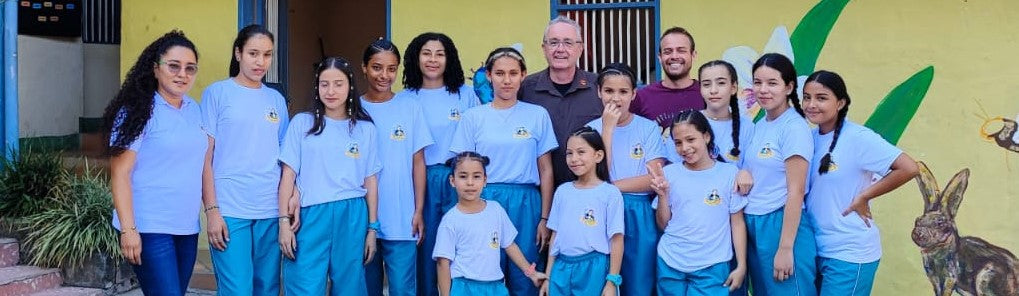
To offer them a protective environment where they can find physical safety and emotional stability – where they can develop their goals and solidify their life plan. The orphanage strives to continue fulfilling this important task in an ideal, sustainable, and continuous manner.

Santa Rosa Orphanage
The Santa Rosa de Lima orphanage is a non-profit organization founded in 1942 in the parish of Ciudad Bolivar. Its work was initiated by the parish priest at the time, Presbyter Rafael Fernández, and supported by the generosity of Mrs. Rosa Posso de Vélez, as well as by several parishioners, including Don Pedro P. Puerta and Don Alejandrino Restrepo.
The orphanage is an institution that pursues the following goals:
Appreciation, appropriate treatment, consideration for differences and equality, meeting the basic needs for affection and love, working responsibly and unconditionally for the well-being of the child, promoting and teaching a sense of belonging and good manners, and thus creating an understanding attitude towards the children in care and becoming aware of their own growth process and personality development.
The task that the house sets for itself:
"The Santa Rosa de Lima orphanage aims to provide accommodation, protection and comprehensive education to children and young people (girls) in vulnerable situations (orphanage, abandonment, high physical and/or moral risk), ensuring the exercise of their rights and the development of integrated individuals for society."

"The Santa Rosa de Lima orphanage will be a model institution for the care, protection and education of vulnerable girls and young people, to guarantee them a better quality of life, to meet their daily needs and to develop their human potential."
Description of the facility
In accordance with its mission, the Santa Rosa de Lima orphanage takes in vulnerable girls who, due to their family, social, and cultural backgrounds, are exposed to situations of physical abuse, sexual abuse, violence, displacement, neglect by their relatives, and other forms of abuse. Given their developmental stage, the orphanage aims to provide comprehensive support to positively influence the emotional development of each girl and the art and way she expresses her life. Currently, the orphanage is seeking additional resources for recreation, relaxation, personal and emotional strengthening, psychological support, academic assistance, and, more generally, a range of activities that foster an environment where they feel useful, regain their self-confidence, discover their talents, and develop skills that will improve their lives.
Among the most common illnesses in children in care are depression, ADHD, personality disorders, aggression and oppositional defiant disorder, as well as phenomena such as cutting and physical self-harm. These are conditions through which they channel and/or outwardly express their anxieties and frustrations arising from the situations they have faced.
The children are taken in because they are in vulnerable situations or because there is no access to education in their communities. In each case, they must pay a monthly fee of 110,000 pesos per child (approximately €25.00), which is covered by a sponsor responsible for this fee. However, it is sometimes difficult to find a sponsor for each of the children in need, which negatively impacts the financial viability of the institution.
Regarding staff support, there is continuous support from two staff members from different departments, one day and the other nights. For psychosocial support, this is provided by the orphanage director, a psychologist and expert in positive psychology, who is also responsible for the overall administration of the orphanage. In addition to the support provided to the children, the orphanage is supplemented by the services of various community secretariats with programs such as prevention and promotion, public health, and disability care, as well as by a legal representative and a nine-member board of directors.

The task:
Currently, the Santa Rosa de Lima orphanage operates the aforementioned process starting Sundays at 5:00 PM. This process begins on Sundays at 5:00 PM when the children arrive at the facility and ends on Fridays at 5:00 PM when the orphanage closes. Minors placed in homes must move between other settings, such as foster families or relatives, who take them in and out during this time. This process, which was initiated and reinforced during the week, returns them to these problematic contexts. This poses a high risk, exposing them to further abuse, extreme poverty, drug use and dealing, and/or prostitution. This situation arises because the facility currently lacks the financial resources to be self-sufficient on weekends. This means that additional staff must be hired for the various departments to cover the weekends, in addition to the costs of food and living expenses during these two days.
:
To ensure the protection and education in the values that define the orphanage as an institution, this process should not be interrupted during weekends, as this would compromise the development and integrity of the mission and vision. As previously mentioned, in most cases, the minors must return to the place where they were abused—that is, a place where they live in constant danger to their physical safety and are exposed to violence, prostitution, drug addiction, and other hostile factors. For this reason, continuous support is necessary, allowing them to develop their own identity, feel protected, included, and important; and feel like an essential part of something, that they belong to a house called Santa Rosa de Lima.
Objectives of the institution
General objective:
To provide a protective environment that enables holistic, constant and uninterrupted support so that the goals of the institution can be fully realized.
Specific goal:
Managing resources to support the operation of the facility on weekends. Creating a safe and supportive environment that fosters academic, psychological, cultural, and religious activities. Providing spaces that allow them to recognize their strengths and abilities, thereby strengthening their personal life plans and adaptability. Facilitating the integration of minors into the community through participation in various activities such as health-promoting and beneficial practices in sports, leisure, culture, education, and religion.
Project costs
To make this project possible, it is necessary to hire an additional staff member for general tasks, a psychologist, a social worker, an educator, and a care assistant. The additional costs for the 25 girls "who constitute our care capacity" have also been calculated for the weekend. Two different budgets are presented, showing the decreasing living costs for a minor in our facility. The first covers the period from Sunday evening to Friday, and the second shows the living costs incurred with continuous care to achieve the desired outcomes for each of our girls.

Milestones:
January 2023
- belated Christmas presents
- 3 computers for schoolwork
- Financing school uniforms
- toys
Since April 2023
- The funding for weekend childcare is initially secured for 6 months.
- "Wishes and Dreams": The children captured their wishes and dreams in drawings. These will now be printed on the coffee sacks during the next import.


And now?
From now on, a "WE" is needed, and we want to contribute our part to the well-being of children in Bolivar, since we also earn our money in Colombia from the work of the local people in the coffee sector - and ultimately we all benefit from it - we want to give something back to this area, and for this, worldwide support from everyone is necessary.
What have we done so far? What's the latest status?
- We have hired an employee who feels called to be an "orphanage ambassador" and is doing everything she can to provide as much support as possible for this project.
- So far, we have been able to inspire several "patrons" who financially support the project within their means.
Our task is to currently seek support!
There is a lack of suitable furniture, learning and school supplies, sometimes even clothing, and the necessary play and recreational opportunities for children. The meager funds barely cover food and clean clothes! Let alone school fees for secondary school. There is also a lack of money to effectively address the "side effects" of the social problems stemming from their backgrounds. Girls frequently suffer from depression, ADHD, personality disorders, aggression, and oppositional defiant disorder, as well as self-harm and other forms of physical injury—they are left to cope with their suffering alone. Can this suffering/failure be quantified? Yes, it can! The orphanage needs an average of 110,000 Colombian pesos per child per month, which translates to €25 for food, accommodation, and clothing.
Now even more important: Protect children with a sponsorship!
Sponsoring a child abroad means helping a child in need grow up, remain in their community, and maintain their ties, thus equipping them for an independent and responsible adult life. By sponsoring a child, you give your sponsored child the chance for a self-determined childhood and a better future.
Help in three ways:
- Support your godchild, their entire "new family" and thus the whole community.
- The most direct way to help.
- Give your godchild the chance to grow up healthy, educated and free from violence.
With a monthly donation of €30 you can support your sponsored child.
Take direct responsibility for a vulnerable child. Here you will find everything you need and want to know about becoming a sponsor at the shelter.
- How does my sponsorship help?
- Will my money actually arrive?
- We answer these and other questions here.
What happens next?
When you become a sponsor, you will receive your sponsored child's name, date of birth, photo, and address. This allows you to stay in touch with your sponsored child. Your child will especially appreciate a personal letter or small gifts, perhaps for their birthday. Your contribution makes a significant difference because, together with local volunteers and the organization, we cover a portion of the infrastructure costs. This means your contribution primarily supports the child's education, medical care, and the children's center where they live.
CONTACT PERSON:
- Mondo del Caffè: Steffi di Pasquale steffi.di.pasquale@mondodelcaffe.de
- Tierra de Cafè: Vanessa Saldarriaga info@tierra-de-cafe.com
- Reismühle Coffee Manufactory nadine@reismühle.de
- Pro Coffee – vending machine service info@pro-coffee.de
How does a sponsorship work and what are its benefits?
This child sponsorship is a very personal and tangible form of support. As a sponsor, you take on the responsibility of providing monthly support for a child living in the shelter.
How much does a sponsorship cost?
Sponsorship offers the opportunity to contribute to the positive development of a child in need with manageable means. By taking on a sponsorship, you make a minimum monthly contribution (30 EUR).
Where does the money go?
The children's shelter is run partly by nuns and partly by volunteers. Thanks to its lean organization, made possible by its limited financial resources, and the support of numerous sponsors and patrons, administrative and organizational costs are kept to a minimum. Therefore, your donation will have a significant impact on the ground. The sponsorship fee is used exclusively for the children's education and medical care.

How long does a sponsorship last?
Sponsoring a child does not create any contractual obligation or commitment for you. You only help for as long as you wish and are able to. Our priority is the child's well-being and that you enjoy helping! If necessary, you can end your sponsorship at any time without notice. In this case, we will try to find a new sponsor for the child. If you wish to end your sponsorship and cancel the direct debit authorization, please send us an email, and we will initiate the cancellation immediately. The cancellation of the direct debit authorization will then take effect no later than 30 days after you are notified of the termination of the sponsorship.
What can I expect from a patent?
Once …
- … you will receive an email update on the current status of the shelter and the children. (See website and Instagram.)
- You can stay informed about the activities of the shelter.
- …we from Mondo del Caffè travel to Colombia once a year to check on the condition of the refuge. We would be happy to invite you to join us and combine this with a wonderful holiday in Antioquia.
- …we will then always offer a LIVE Zoom meeting from the house with all sponsors to discuss what is coming up, what has been achieved and where there are still problems.
- …The sponsorship allows for personal contact with the child, but this is not a requirement. The child greatly appreciates regular letters (emails) and small gifts for birthdays and Christmas. Please bear in mind that these children are traumatized by their terrible life experiences. Please do not expect an immediate reply to your letters. These children are afraid of being hurt and need time to trust you. Many of these children have never written a letter before. Since we have German- and English-speaking colleagues on site, translating into Spanish is then a breeze!
What can I give my godchild as a gift?
Giving gifts should bring joy. For you, it's the joy of making a child in need happy; for your sponsored child, it's immense joy to receive a personal gift. The gift should be age-appropriate. We can source everything for you locally, so there are no shipping or additional costs. You just need to write the letter or email yourself. It doesn't have to be expensive, but it should be something that brings benefit and joy. The wishes and longings of the children there are no different from those of any other children in our one world.
How can I communicate with my godchild and the shelter?
You are sponsoring a child who may never have had anyone, or who has lost that person, to send them a gift for their birthday or Christmas – just like that. The children are very happy about the contact and spontaneously write a letter or draw a picture. For some, however, the situation is new. They cannot express their gratitude and their feelings. Please don't be disappointed in this case. Since you are also in direct contact with the shelter (if you wish), you have the opportunity to get in touch directly with the child's caregivers. Of course, we all assume that we must communicate with discretion. The work of the sisters on site is already demanding enough, and we don't want to burden them with numerous inquiries. Should you notice anything unusual or if you are concerned, please contact us.
Download our information brochure about the refuge in Santa Rosa de Lima, Colombia.


